Say you're comparing two listings on the same bay. Both advertise 100 feet of waterfront. Both show a dock in the photos. On paper, they look interchangeable, and the only real decision is which kitchen you like better.
They are not interchangeable. New Hampshire measures shoreline frontage differently than the tape measure a seller's agent used for the flyer, and that difference decides how many boat slips you're allowed, whether you can add a boat lift, and in some cases whether the dock in the photo is even legal to keep as it stands. None of that shows up in the listing price. It shows up after closing, when you call the town to ask about a permit and find out the number you thought you owned isn't the number the state uses.
That gap between the number on the sheet and the number that governs your use of the water is the real story of Winnipesaukee waterfront right now, and it matters more in 2026 than it has in years, because sellers and buyers are pricing the lake very differently than they were even twelve months ago.
Frontage on the flyer is not frontage under the law
New Hampshire's Wetlands Bureau does not use the straight-line distance between your property pins to calculate what you're allowed to build. It averages two numbers: the straight pin-to-pin distance and the actual curved length of the shoreline itself. If your lot juts out on a point or curves into a small cove, those two measurements can differ by a meaningful margin, and the state uses the average, not the bigger of the two.
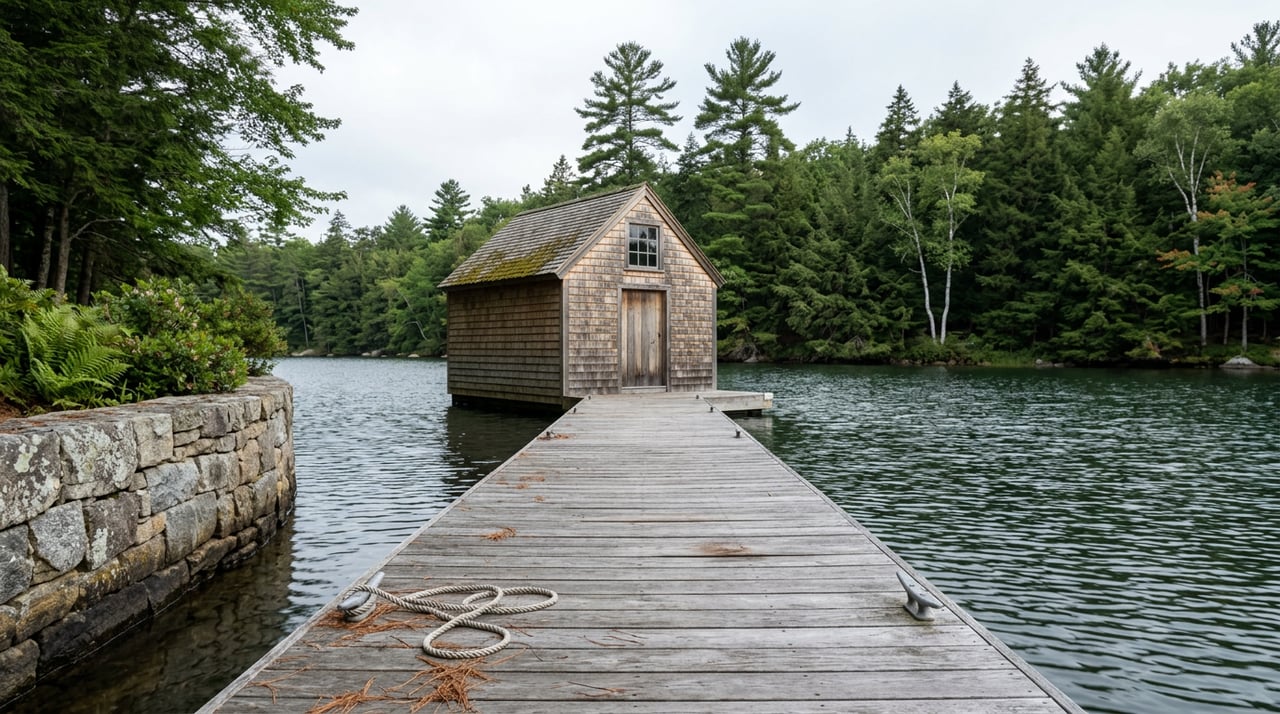
That average frontage number then determines how much dock you're allowed. The first 75 feet of average frontage earns two boat slips, which is typically one dock with a slip on each side. Every additional 75 feet adds one more slip. A lot just under 75 feet of average frontage doesn't automatically get a dock at all. The New Hampshire Department of Environmental Services spells this out plainly in its freshwater dock permitting guidance, including the fact that Winnipesaukee is the only lake in the state large enough to use the bigger boat slip dimensions under the rule, since it's the only New Hampshire lake over 10,000 acres.
Here's the part that surprises even longtime lake families: for lakes and ponds larger than 10 acres, New Hampshire owns the lakebed. Your deed can convey frontage, but it generally doesn't convey the ground under the water.
For lakes or ponds larger than 10 acres, the state owns the bed of the lake. Your permit allows you to install your dock on or over state land.
That distinction isn't hypothetical. In 2025, the New Hampshire Supreme Court weighed in on a Winnipesaukee case that turned entirely on this point. A Winnipesaukee property owner had built a deck and stairway that extended out over the lake's surface, arguing the structure sat over land they believed they owned beneath the waterline. The court sided against them, holding that a structure extending over public water falls under state permitting rules regardless of what the landowner assumes about the ground underneath, a principle grounded in RSA 482-A:26. The legal analysis of the ruling makes clear the takeaway for anyone buying waterfront here: what you think you own and what the state regulates are two different questions, and the second one wins.
For a buyer, the practical move is simple but often skipped. Before you fall for the frontage number in the listing, ask for the permit history on the dock. It tells you what's actually approved, what might be grandfathered, and whether there's room under the 75-foot rule to add a lift or a second slip if your plans call for more than one boat.
Why the asking price and the closing price are pulling apart
The frontage confusion matters more this year because the market itself has shifted from a seller's game to something closer to a negotiation. Twenty-nine waterfront single-family homes closed on Lake Winnipesaukee in the first half of 2026, for a combined $92.6 million, a 43 percent jump in dollar volume and a 16 percent increase in unit sales compared with the same period in 2025. The median closed price landed at $2.3 million. The year's biggest sale so far closed at $12.3 million for a property on Black Cat Island in Meredith, underscoring that the top of the market hasn't softened at all.
But look at what's sitting on the market rather than what already sold. As of late June 2026, there were 46 active Winnipesaukee waterfront listings carrying a median asking price of roughly $2.5 million, a full 8 to 9 percent above the median price actually closing. That spread is the tell. Sellers are still pricing off the run-up years, while buyers are treating the asking price as a starting point rather than a target.
Days on market backs this up. From January 1 through April 17, 2026, the dozen Winnipesaukee homes that closed took a median 72 days to sell, up from 65 days for the same window in 2025. That's not a market in decline. It's a market where buyers are taking the extra week or two to ask the questions this article opened with, about docks, permits, and what the frontage number actually means, before they write an offer.
None of this means waterfront is cooling in any broad sense. Waterfront properties overall still command a premium of 40 percent or more above comparable non-waterfront homes in the region. It means the easy, no-questions-asked bidding wars of the past few years have given way to buyers doing more homework before they commit, which is exactly the environment where the dock and frontage details stop being fine print and start being negotiating leverage.
The tax line that moves the math more than the sale price does
Frontage and permits are one hidden variable. Property taxes are another, and the spread between towns around the same lake is larger than most buyers expect walking in.
Under the most recent town tax-rate filings, Gilford's rate came in at $11.85 per thousand dollars of assessed value, while Moultonborough's rate sat at $5.33 per thousand, a spread of more than double on properties that can otherwise look nearly identical from the water. Run that against a home assessed at $1.5 million, a reasonable midpoint for a solid but unexceptional Winnipesaukee waterfront property, and the annual town tax bill lands near $7,995 in Moultonborough versus roughly $17,775 in Gilford. That's a difference of almost $9,800 a year, every year, regardless of what you paid at closing.
That gap exists because towns with heavy concentrations of seasonal and waterfront homes generate outsized tax revenue relative to their demand on schools and municipal services, which lets them keep rates low without cutting services for full-time residents. It's a real, structural difference between towns on the same lake, not a reflection of home quality or condition, and it belongs in the same conversation as the purchase price, not as an afterthought after closing.
Reading two listings side by side
Put the pieces together and the comparison a lake buyer actually needs to make looks different from the one most portals set up for you. Two homes with the same frontage number, similar square footage, and similar asking prices can carry meaningfully different costs of ownership and different water rights, depending on:
- Which town holds the deed, since the tax-rate spread alone can rival a car payment every year
- Whether the average frontage calculation, not the pin-to-pin number, clears the 75-foot threshold for a second boat slip
- Whether the existing dock's permit history shows it as legally sized and located, or whether any changes would trigger a new state review
- How the asking price compares to what's actually closing on that stretch of shoreline this year, not what closed two or three years ago
None of these show up in a search filter. They show up in a conversation with someone who has looked at the permit file, walked the shoreline, and watched how this particular market has moved through 2026.
A few questions buyers ask before they commit
Does 100 feet of frontage always mean the same dock rights everywhere on the lake? No. The state calculates average frontage using both the straight pin-to-pin line and the actual curved shoreline length, so a curved lot and a straight lot with the same advertised footage can qualify for different numbers of boat slips.
If my dock has been there for decades, am I automatically covered? Not necessarily. Existing structures can be grandfathered, but changes, repairs that alter size or location, and additions like a boat lift generally require their own permits. Requesting the permit history before closing is the only way to know what you're actually inheriting.
Buying or selling waterfront on this lake rewards the kind of attention that comes from years of walking these shorelines, not from a search filter. Chip Hornbeek Realty has spent decades on the building and renovation side of Lakes Region property before bringing that knowledge into real estate, which is exactly the perspective worth having before you make an offer on a dock permit you haven't seen yet. Contact Chip for a free lake-market consultation before your next Winnipesaukee showing.