Wolfeboro's Select Board voted on May 6 to keep the town's outdoor water ban in place. The minutes record Public Works Director Steve Randall saying he "hopes this is temporary since lakes are high."
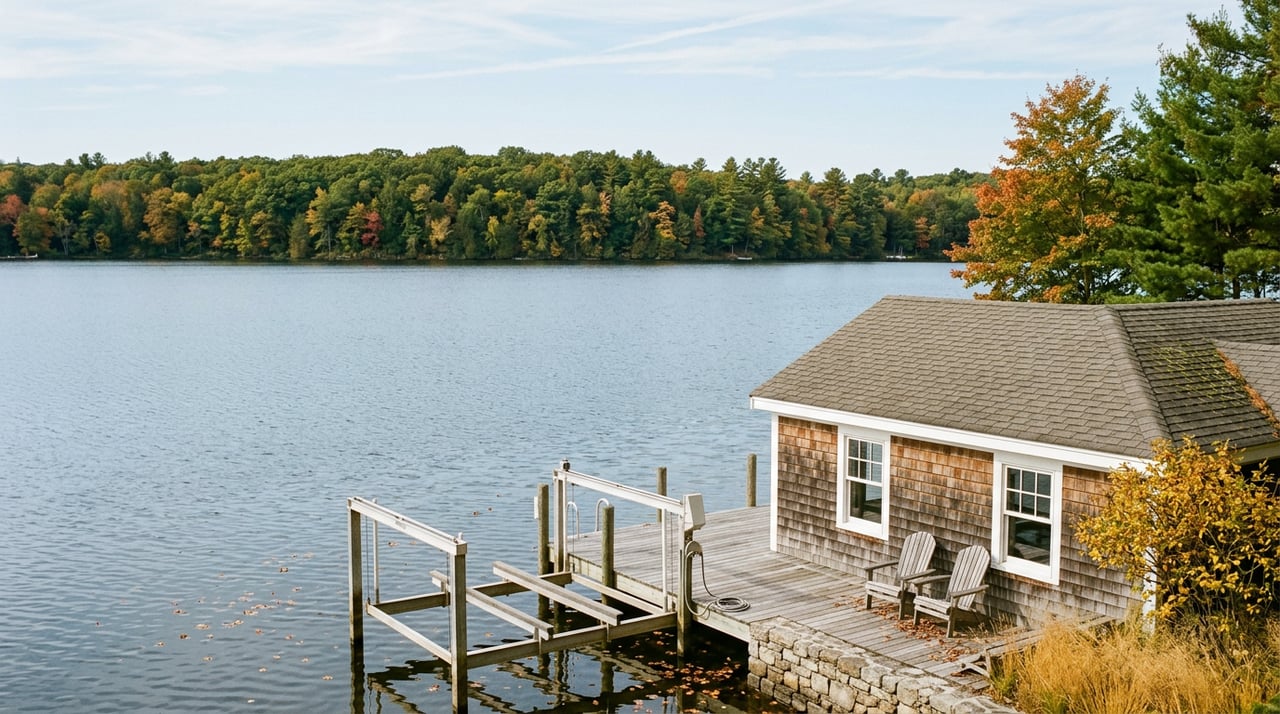
Five months later, the lakes have been high all along and the ban is still on. On October 8 the Town said it will "Maintain water-use restrictions." If you're on town water and have been looking at Winnipesaukee from your yard and wondering why you can't run a hose, the answer is geography. Wolfeboro's tap water doesn't come from the lake you can see.
One pond, and no valve on it
The Town's 2021 Consumer Confidence Report calls Upper Beech Pond on Beech Pond Road the town's "sole source of drinking water." It describes the pond as 136 acres and spring-fed. Untreated pond water flows by gravity to the treatment facility on North Line Road, where it is treated before it goes out to customers. That report covers 2020 data and is the most recent one in our research. This year's Select Board minutes call the supply "Beach Pond," and the Town's October notice calls it the "Town Reservoir."
Winnipesaukee is about 69 square miles. The pond that fills Wolfeboro's pipes is 136 acres. Rain that lifts the big lake doesn't necessarily refill the small reservoir, and the reservoir is what the Water Department has to manage.
The Town's October 8 notice explains the other half of the problem. The reservoir "does not have a dam or controlled outlet that Town staff can operate to regulate its elevation." It is naturally contained. When the water gets high enough, it spills over a natural berm into the wetland next door. Staff can't close a gate to hold water back for a dry stretch. Once the pond drops, the town's options are to wait for recharge or reduce demand. The ban is how it reduces demand.
How the year unfolded at Beach Pond
Select Board minutes and Town notices track the pond through 2026:
- April 28. Randall wrote the memo the May vote relied on. The records we reviewed don't show when the ban was first imposed. The May action continued a ban that was already in place.
- May 6. Beach Pond was down 24 inches, which the minutes call "not typical for this time of year." The Board voted 5–0 to continue prohibiting all outdoor water use for Water Department customers.
- June 3. The Town Manager reported the pond was "still 13-inches low; recovered somewhat," and said the moratorium should continue "for about another month." The Board also discussed water sources and a capacity study.
- July 1. Select Board member John Thurston described his June 9 visit to the reservoir. He referred to a full level of 983 feet above sea level and an old stone wall standing about 13 inches above the water surface, which he believed would let the pond rise higher. He told the Board he "could not find justification" for keeping the ban. The minutes record that as his argument. The Board didn't adopt it as a finding.
- September 16. The Board's agenda listed "Approval: Water Regulations Update- Public Works" and "Discussion: Status of Public Water supply (reservoir)."
- September 18. A Town Alert announced that the Select Board had declared a water supply shortage under Town Code § 167-6 and listed the restrictions now in effect.
- October 8. The Town said no water was flowing out through the overflow area, and that the historical and engineering record "does not support the current reservoir, by itself, as an immediate water-supply emergency." It kept the restrictions anyway, along with monitoring, leak detection and repair, and tracking of weather and recharge. The notice attributes this update to a September 7 Select Board meeting. The Board's posted calendar shows meetings on September 2 and September 16.
The Town isn't calling it an emergency. It's managing a reservoir that hasn't refilled to the point of overflowing, and it has no outlet it can adjust.
The wider dryness backs that up. The U.S. Drought Monitor's map for data valid October 6, 2026 showed 55.68 percent of New Hampshire in drought and none of the state in the more severe D2 through D4 categories. Those numbers are statewide, not specific to Carroll County. Even so, a spring-fed pond in a dry stretch recharges slowly, whatever the big lake is doing.
The code had gentler settings. The town chose the strictest.
Chapter 167 of the Wolfeboro Town Code gives the Select Board a menu of restrictions once it declares a water supply shortage. It ranges from watering schedules to outright bans:
- Option A limits lawn and landscape watering to designated days.
- Option G limits non-commercial car and boat washing to those same designated days.
- Option D prohibits all outdoor water use.
- Option H prohibits non-commercial car and boat washing entirely.
The September 18 alert uses neither designated-days option. It imposes the full prohibition on outdoor water use, bans non-commercial car and boat washing outright, and also bans automated sprinklers, pool filling, and washing streets, driveways, sidewalks, or other paved surfaces. That's why there's no odd-even schedule to look up this fall. The alert sets no watering days at all.
The code also protects some uses. Water for firefighting, health, sanitation, medical purposes, and other essential uses can't be restricted, though the code encourages conservation indoors.
What that means for October chores
The ban hits hardest on chores that cluster in the fall.
Boats coming out of the water. Washing a boat at home on town water falls under the non-commercial washing ban. In May, Randall told the Board the restrictions don't apply to commercial car washes because they use recycled water. Wolfeboro Carwash at 35 Center Street in Clarke Plaza offers automatic touch-free and self-service bays and says it is open 24 hours a day, seven days a week. On the marine side, Executive Detail advertises boat washing and acid washing of hulls. Its own site lists 7 Pine Street, while the Chamber directory lists it with the car wash at 35 Center Street.
Gardens and plantings. The alert has one watering exception: low-volume irrigation of "crops for use as food by residents at a primary residence." Lawn and landscape irrigation is otherwise prohibited, and so are automated sprinkler systems.
Pools, patios and driveways. Filling a pool and hosing down paved areas are both prohibited.
Running hydrants. You may see Public Works opening hydrants this season. The Town scheduled fall hydrant flushing from October 5 through approximately November 30 and warned that customers may see temporarily discolored water or low pressure.
Who the ban covers
The ban applies only to customers of the Town of Wolfeboro Water Department. It "does not restrict usage of private wells or other means of watering which are outside of the Municipal Water System." The code says the same thing more broadly. Restrictions don't apply to people drawing from other sources unless that use can be clearly shown to directly affect the public supply. In practice, two neighbors on the same road can be under different rules.
Drilling a private well isn't a quick workaround for a town water customer. When a Board member asked about it in May, Randall said it was a planning department and ZBA question and that a variance would be needed.
Enforcement is set out in the code. The Wolfeboro Police Department investigates alleged violations and issues citations. Fines are $100 for a first offense, $200 for a second, and $500 for each offense after that. Civil penalties under state law can reach $10,000 per day. The code also lets the Select Board stop supplying water to a violator until it decides the risk of further violations has passed.
How the ban ends
The code doesn't set an end date. It says the Board may end or amend the restrictions once it determines "that a water supply shortage no longer exists or that the restrictions in place should be amended," with public notice. The October 8 notice lists what the Town is watching: reservoir levels and demand, leak repairs across the system, and weather and recharge.
The new Public Works Updates page is where reservoir level updates will be posted, according to the Town. Questions go to the Public Works office at 603.569.8176. The Board's posted calendar doesn't show a September 7 meeting, and minutes for the September 16 and October 7 meetings weren't posted yet when we checked, so that page and future Select Board minutes are the place to watch for a change in the pond.
This year shows why it matters how a home gets its water. A house on the municipal system and a house on a private well can sit side by side under different rules. If you're weighing a Wolfeboro property and want to understand how its water supply works before you commit, Chip Hornbeek Realty can go over it with you. Contact Chip for a free Lake‑Market consultation.
This article is general information, not legal, tax or financial advice. Consult a qualified professional about your situation.